Cameras 7 Cameras That Capture the Night Sky Clearly
P
By the Pickpedia Team
·7 picks compared
·Last verified October 2026
Affiliate disclosure: As an Amazon Associate, Pickpedia earns from qualifying purchases. Links on this page are paid links, and we may earn a commission at no extra cost to you. This never affects our picks or scores.
Quick answer
For clear night sky shots, smart telescopes like the Dwarf 3 and Seestar S30 Pro handle tracking, stacking, and processing automatically. A DSLR such as the Rebel T7 or the OM System mirrorless suits shooters who want manual control and interchangeable lenses. Match the tool to your patience and setup.
7 Cameras That Capture the Night Sky Clearly at a glance
Why you can trust this guide
We compared these picks using verified manufacturer specifications, available manuals and documentation, current retailer listings, and patterns in owner feedback, alongside editorial research. We focus on measurable differences such as performance, capacity, usability, and build quality. Pickpedia does not present editorial research as laboratory testing, and we do not claim hands-on testing unless it was actually performed.
How we chose: Seven cameras compared across portability, sensor capability, tracking, low-light handling, and how much setup each demands before you get a usable image.
Photographing the night sky splits into two camps. Smart telescopes point, track, and stack for you through an app, while traditional cameras hand you full manual control and a lens ecosystem. Both can produce clear results, but they ask very different things of your time and learning curve.
We looked across specifications, owner reports, and how each unit is described by its maker. Some finds a target in minutes and processes in the cloud; others reward patience with editing and a proper mount. Below, seven options grouped by who each one really serves.
Our top picks
Weighing about 3 pounds, the Dwarf 3 fits a standard backpack and, per its listing, sets up in roughly two minutes. A dual-lens system pairs a telephoto for deep-space objects with a wide-angle for Milky Way and star-trail framing. Its 4K auto-tracking follows celestial targets, and one-touch cloud processing through the DWARFLAB app enhances shots without a PC. Owners describe it as approachable for beginners yet flexible enough for experienced users. The main limitation is dependence on the app and cloud pipeline, so your workflow leans heavily on connectivity and the software rather than manual control.
WeightAbout 3 lb / 1.35 kg
OpticsDual lens, telephoto plus wide-angle
Tracking4K auto-tracking
ProcessingApp with cloud enhancement
Pros
- Very portable, fits a normal backpack
- Dual lens covers deep-space and wide-field
- Fast, beginner-friendly app workflow
Cons
- Leans on cloud and app connectivity
- Less manual control than a DSLR
Check price on Amazon ›
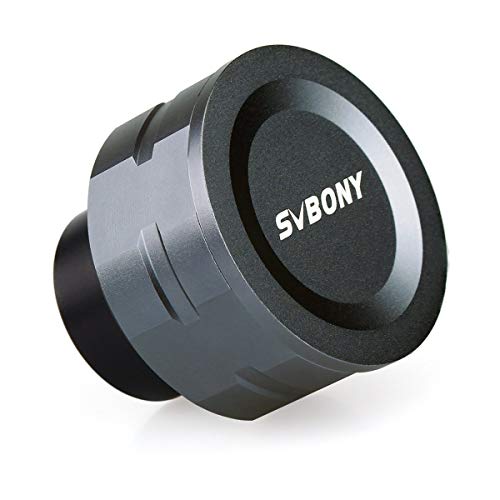
Built as a starter route into astro imaging, the SV105 replaces a 1.25-inch eyepiece and streams the view to a laptop or PC. Reviewers point to its strength with the moon and bright planets: aim, record a quick video, and share the result. A 1/2.8-inch IMX307 sensor delivers up to 30 frames per second at 1920x1080 and can record 2K video, while dark-light compensation lifts clarity in low light. It runs plug and play with no driver, though you supply capture software per platform. Its clear limitation is scope: this is a planetary and lunar camera, not a deep-sky tool, and it needs a telescope to work at all.
Sensor1/2.8 inch IMX307 CMOS
Video2K, up to 30 fps at 1080p
FitStandard 1.25 inch, M28.5x0.6
SetupPlug and play, no driver
Pros
- Simple entry into astro imaging
- Strong on moon and bright planets
- Plug and play across major systems
Cons
- Requires a telescope to use
- Aimed at lunar and planetary, not deep sky
Check price on Amazon ›
As a general DSLR, the Rebel T7 gives you a 24.1 megapixel APS-C CMOS sensor and a native ISO range to 6400, expandable to 12800, which matters for pulling faint light. Built-in Wi-Fi and NFC ease transfers, and the kit ships with an 18-55mm lens plus access to Canon EF and EF-S glass. For astro work, its real appeal is manual exposure control and a lens system you can grow into. The trade-off is that it does none of the tracking or stacking for you: nightscapes need a tripod and steady technique, and deep-sky targets call for a separate mount. The 9-point autofocus is also basic by current standards.
Sensor24.1 MP APS-C CMOS
ISO100 to 6400, expandable to 12800
ConnectivityWi-Fi and NFC
Lens mountCanon EF / EF-S
Pros
- Full manual control for long exposures
- Large APS-C sensor gathers light well
- Grows with the Canon EF lens system
Cons
- No built-in tracking or stacking
- Modest 9-point autofocus
Check price on Amazon ›
This mirrorless body pairs a 20.4 megapixel Four Thirds BSI stacked CMOS sensor with a native ISO range of 200 to 25,600, which the maker positions for low-light shooting with minimal noise. At roughly 14.56 ounces it stays light enough for travel and long sessions. Micro Four Thirds mounting opens a wide lens selection from wide-angle to telephoto, and video reaches 4K at up to 60fps in 10-bit. Rapid autofocus rounds out a flexible package. Its limitation for astro buyers is the smaller Four Thirds sensor area versus APS-C or full frame, so very faint deep-sky work may demand more careful exposure stacking and good glass.
Sensor20.4 MP Four Thirds stacked BSI CMOS
ISO200 to 25,600
WeightAbout 14.56 oz / 413 g
Video4K up to 60fps, 10-bit
Pros
- Light and travel-ready system camera
- Broad Micro Four Thirds lens choice
- Strong low-light and 4K video specs
Cons
- Four Thirds sensor smaller than APS-C
- Faint deep-sky needs careful stacking
Check price on Amazon ›
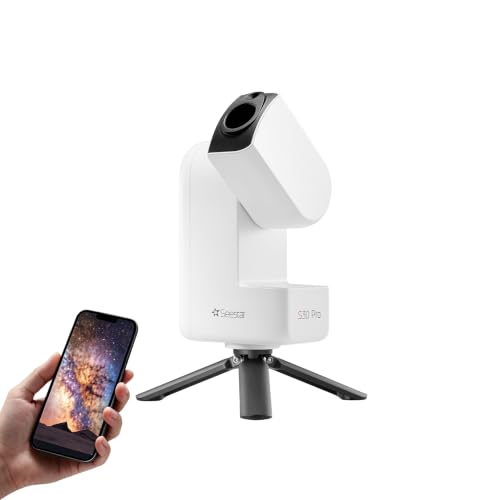
Aimed at beginners, the Seestar S30 Pro powers on, connects to its app, and uses automatic GOTO to find and track targets for you. Apochromatic optics and built-in light-pollution filters help it hold contrast in bright urban settings, which is its standout trait. Dual-camera 4K imaging and one-tap modes cover the Milky Way, star trails, planets, and galaxies, with AI noise reduction and automatic mosaic stitching handling the processing. At 3.64 pounds with anti-dew protection, it travels well and shoots all night. The catch is the same as any sealed smart scope: you work within the app and its fixed optics rather than swapping lenses or dialing manual settings.
Weight3.64 lb
OpticsApochromatic, light-pollution filters
ImagingDual-camera 4K
TrackingAutomatic GOTO
Pros
- Filters help against city light pollution
- Automatic GOTO finds and tracks targets
- One-tap modes with AI noise reduction
Cons
- Closed system, no lens swapping
- Workflow tied to the app
Check price on Amazon ›
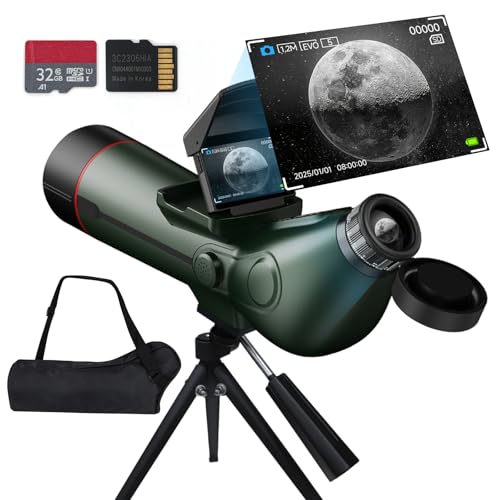
This refractor pairs an 80mm aperture and 300mm focal length at f/8.89 with a starlight-grade sensor rated up to 350X magnification and 4K capture. Its distinguishing feature is a dual-display design: an eyepiece with plus or minus 4 diopter adjustment plus a foldable external screen with a built-in sunshade for daytime clarity. One-touch photo and video modes need no extra device, storage expands to 512GB, and a 4500mAh battery runs up to 6 hours with auto shut-off timers. It doubles for birdwatching and long-distance viewing. The limitation is that very high stated magnification numbers rarely translate to usable detail, so temper expectations and lean on lower, steadier settings.
Aperture80mm, 300mm focal length (f/8.89)
DisplayEyepiece plus foldable external screen
StorageUp to 512GB external
Battery4500mAh, up to 6 hours
Pros
- Dual eyepiece and external screen
- One-touch photo and video capture
- Long battery life with auto shut-off
Cons
- High magnification claims oversell real detail
- General-purpose optics, not deep-sky tuned
Check price on Amazon ›
This eyepiece camera clamps onto gear you already own, with a universal groove fitting eyepieces from 23mm to 60mm across telescopes, binoculars, monoculars, and microscopes. An 8MP CMOS sensor supports 4K video and up to 64MP stills, and low-light compensation sharpens the moon, planets, and wildlife in dim conditions. A rotatable IPS screen shows a live view, while WiFi within about 32 feet lets two devices connect at once. A 2000mAh battery and 512GB microSD support cover long sessions, and the XDVPRO app adds time-lapse and timed shooting. Its limitation is versatility over specialization: results depend heavily on the host optics it attaches to.
Sensor8MP CMOS, 4K video, 64MP stills
FitUniversal, 23mm to 60mm eyepieces
WirelessWiFi within about 32 ft
Power2000mAh, 512GB microSD
Pros
- Fits a wide range of eyepieces
- Live IPS screen plus WiFi viewing
- App adds time-lapse and timed shooting
Cons
- Image quality depends on host optics
- Not a standalone imaging system
Check price on Amazon ›
What to look for
Smart telescope or traditional camera
Smart scopes handle pointing, tracking, and stacking through an app, so you get an image fast with little know-how. A DSLR or mirrorless body hands you manual control and a lens system, but expects you to learn exposure and often add a mount. Decide how much of the work you want automated.
Why sensor and ISO matter
Astro shots capture faint light, so a larger sensor and a usable high-ISO range help pull detail from a dark sky. APS-C bodies gather more light than compact sensors, while stacked designs manage noise. Numbers only tell part of the story: technique and stacking still shape the final result.
Light pollution and location
City skies wash out faint targets, which is why built-in light-pollution filters and apochromatic optics matter for urban users. Reviewers note that darker sites always help, but filtered smart scopes narrow the gap. If you rarely leave town, prioritize a tool that fights glow directly.
Portability and setup time
Weight and setup speed decide whether the gear actually leaves the house. Lightweight smart scopes near 3 pounds and compact mirrorless bodies travel easily and start in minutes. Heavier or mount-dependent setups reward planning, so match the format to how spontaneous your night sessions tend to be.
Frequently asked questions
Do I need a separate telescope for these?
It depends on the type. Smart telescopes like the Dwarf 3 and Seestar S30 Pro are self-contained. Eyepiece cameras such as the SV105 and the 4K wireless unit require a telescope. Traditional cameras like the Rebel T7 and OM-3 work with lenses and, for deep sky, a tracking mount.
Which option is easiest for a complete beginner?
Smart telescopes are the gentlest start. Both the Dwarf 3 and Seestar S30 Pro power on, connect to an app, and automate targeting, tracking, and processing. Owners report usable images on a first night, with setup measured in minutes rather than a long learning curve.
Can I shoot deep-sky objects, not just the moon?
Some tools yes, some no. The Dwarf 3 and Seestar S30 Pro are built for deep-sky and wide-field work. The SV105 is aimed mainly at the moon and bright planets. DSLR and mirrorless bodies can reach deep sky, but usually need a tracking mount for long exposures.
How important is low-light performance?
Very. Night skies are dim, so low-light handling separates clear results from noisy ones. The OM-3 lists an ISO range to 25,600, the Rebel T7 reaches an expanded 12800, and several eyepiece cameras add dark-light compensation to lift clarity in dim conditions.
Will these work under city lights?
The Seestar S30 Pro is built for it, with apochromatic optics and built-in light-pollution filters that hold contrast in bright surroundings. Other tools still benefit from darker skies. If you shoot mostly in town, prioritize filtering and apochromatic optics over raw magnification.
Do I need a computer to process images?
Not always. Smart telescopes process in-app, and the Dwarf 3 adds cloud enhancement with no PC needed. Eyepiece cameras like the SV105 stream to a laptop for capture. Traditional cameras give you raw files you can edit later on whatever software you prefer.
What about battery life for long nights?
Several units are built for all-night sessions. The dual-screen refractor lists a 4500mAh battery for up to 6 hours, the 4K wireless camera uses a 2000mAh cell, and the Seestar adds anti-dew protection for extended imaging. Carrying a power bank is still wise for marathon nights.
Is high magnification the most important number?
No. Very high magnification claims, like the 350X figure on the dual-screen refractor, rarely translate into usable detail because atmosphere and stability limit sharpness. Aperture, sensor quality, and steady tracking matter more. Treat headline magnification as a ceiling, not a working setting.
The verdict
DWARFLAB Dwarf 3 Smart Telescope
9.2/10
For most people, the DWARFLAB Dwarf 3 earns the top pick: light, fast to set up, and capable across deep sky and wide-field. City shooters should look hard at the Seestar S30 Pro for its light-pollution filters. Choose the Rebel T7 or OM-3 if you want manual control and a lens system, and the SV105 or wireless eyepiece cameras if you already own a scope and want to add imaging.
Check price on Amazon ›
Our top pick, secure checkout via Amazon
Note: Availability and specifications change often. Always confirm the current details on Amazon before buying.