Lenses 5 85mm Portrait Lenses for Beautiful Bokeh
P
By the Pickpedia Team
·5 picks compared
·Last verified October 2026
Affiliate disclosure: As an Amazon Associate, Pickpedia earns from qualifying purchases. Links on this page are paid links, and we may earn a commission at no extra cost to you. This never affects our picks or scores.
Quick answer
Pick an autofocus 85mm like the Meike SE II or Canon RF f/2 if you shoot fast portraits, or a Nikon Z 85mm f/1.8 S for weather sealing. Manual Lightdow-style primes suit patient hobbyists who enjoy hands-on focusing and want maximum background separation.
5 85mm Portrait Lenses for Beautiful Bokeh at a glance
Why you can trust this guide
We compared these picks using verified manufacturer specifications, available manuals and documentation, current retailer listings, and patterns in owner feedback, alongside editorial research. We focus on measurable differences such as performance, capacity, usability, and build quality. Pickpedia does not present editorial research as laboratory testing, and we do not claim hands-on testing unless it was actually performed.
How we chose: We compared five 85mm portrait lenses, weighing autofocus, aperture, bokeh quality, build sealing, and mount compatibility across their listed specifications.
An 85mm focal length sits in the classic portrait range, flattering faces with gentle compression and pushing backgrounds into soft blur. This roundup mixes manual-focus EF primes, autofocus options, and sealed mirrorless glass, so there is something for beginners and working shooters alike.
Rather than claiming lab testing, we grounded every note in the manufacturer specifications and how reviewers describe real use. Read each entry for its aperture, focus system, and mount before matching a lens to your camera body.
Our top picks
Canon designed this compact RF lens to double as a portrait and macro tool, reaching 0.5x magnification with a minimum focusing distance near 1.15 feet. A bright f/2 aperture keeps backgrounds soft, and optical image stabilization adds up to five stops of shake correction, with hybrid IS helping during close focusing. A handy control ring lets you change settings directly on the barrel. It pairs with full-frame RF bodies including the EOS RP, R, R5, and R6. The main trade-off is the f/2 aperture, slightly narrower than f/1.8 rivals, so extreme subject isolation is a touch gentler.
Focal length85mm
Aperturef/2
StabilizationUp to 5 stops
MountCanon RF full frame
Pros
- Doubles as a 0.5x macro lens
- Five-stop image stabilization steadies shots
- Control ring speeds up handling
Cons
- f/2 slightly slower than f/1.8 primes
- RF mount only, no EF or crop support
Check price on Amazon ›
This fully manual 85mm f/1.8 asks you to set focus, shutter, ISO, and aperture yourself, which many owners find sharpens their craft. Six rounded aperture blades plus an internal focus mechanism produce smooth, dreamy background blur, while hybrid aspherical elements and multi-coating help control glare and aberrations. Compatibility spans a wide list of Canon EOS Rebel and higher DSLR bodies. One clear limitation stands out: with no electronic contacts, the camera reports no lens, so you must switch to full manual mode and enable shutter release without a lens. Patient shooters will enjoy the freedom.
Focal length85mm
Aperturef/1.8
FocusManual only
MountCanon EF DSLR
Pros
- Six rounded blades render soft, pleasing bokeh
- Wide Canon DSLR body compatibility
- Manual control builds real photographic skill
Cons
- No autofocus or electronic contacts
- Requires menu tweaks to fire the shutter
Check price on Amazon ›
Meike brings autofocus to the EF mount with an STM stepping motor that reviewers note runs quiet and smooth, plus electronic aperture and EXIF transmission. An optical design using 7 groups and 11 elements aims for high-resolution rendering, and the f/1.8 aperture separates subjects with natural blur. Minimum focus distance sits at 0.65m, and a USB-C interface allows firmware upgrades over time. It fits many Canon EF bodies from the 5D series to Rebel models. Keep in mind the maximum magnification is only 0.17x, so this is a portrait tool rather than a close-up macro option.
Focal length85mm
Aperturef/1.8 to f/16
FocusAutofocus STM
Optics11 elements, 7 groups
Pros
- Quiet autofocus with EXIF support
- USB-C firmware updates keep it current
- High-resolution optical design
Cons
- Low 0.17x magnification limits close-ups
- EF mount only, not for mirrorless
Check price on Amazon ›
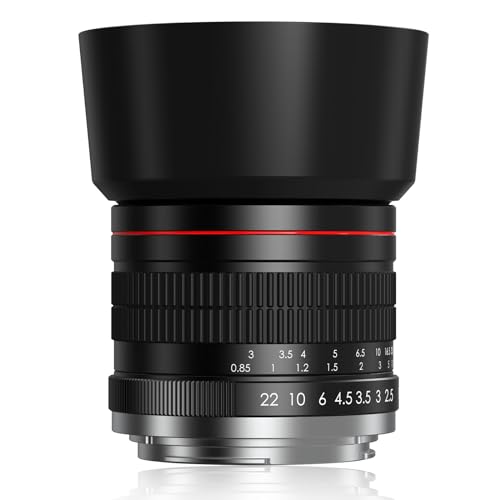
This manual EF prime targets photographers who enjoy rotating the focus ring for sharp, deliberate portraits and street shots. Its large f/1.8 aperture delivers pleasing background bokeh and shallow depth of field, helping subjects stand out. The 85mm framing handles half-body, full-body, and tight facial close-ups with ease, and compatibility covers a broad range of Canon DSLR bodies from Rebel models to the 5D series. As with other fully manual designs, it carries no electronic contacts, so your camera will not detect it and you must set the mode dial to manual and adjust aperture on the lens ring itself.
Focal length85mm
Aperturef/1.8
FocusManual only
MountCanon EF DSLR
Pros
- Large f/1.8 aperture for strong bokeh
- Flexible framing from headshots to full body
- Broad Canon DSLR compatibility
Cons
- No autofocus and no electronic contacts
- Aperture adjusted only via lens ring
Check price on Amazon ›
Nikon built this Z-mount prime for demanding portrait work, pairing an f/1.8 aperture with a nine-blade diaphragm for soft, rounded highlights. Two ED glass elements and Nano Crystal coating aim for lifelike color and reduced flare, while a customizable control ring puts a chosen setting at your fingertips. Extensive sealing makes it dust and drip resistant, a genuine advantage for shooters working outdoors. The obvious limitation is mount specificity: it is designed for Nikon Z series mirrorless bodies only, so DSLR and other-brand users will need an adapter or a different lens entirely.
Focal length85mm
Aperturef/1.8
DiaphragmNine blades
MountNikon Z mirrorless
Pros
- Dust and drip resistant sealing
- ED glass and Nano coating cut flare
- Nine blades for rounded, smooth highlights
Cons
- Nikon Z mount only
- No image stabilization built in
Check price on Amazon ›
What to look for
Why 85mm Flatters Faces
This focal length compresses features gently and keeps a comfortable working distance, so subjects relax and proportions look natural. It became a portrait standard because it isolates a face without the distortion wider lenses introduce up close.
Autofocus Versus Manual
Autofocus lenses like the Meike and Canon RF suit events, kids, and quick candid moments. Fully manual primes reward patience and teach exposure fundamentals, though they slow you down and demand practice for consistently sharp eyes.
Reading the Aperture
An f/1.8 opening blurs backgrounds more aggressively than f/2, giving stronger subject separation. Rounded aperture blades, six on the Lightdow and nine on the Nikon, shape how out-of-focus highlights render, from soft circles to smoother transitions.
Matching the Mount
Confirm your camera before buying. EF options fit Canon DSLRs, RF suits Canon mirrorless, and the Nikon Z lens serves Z-series bodies. A mismatched mount means poor function or the need for an adapter, so check compatibility lists carefully.
Frequently asked questions
Is 85mm good for portraits?
Yes. Its natural compression flatters facial features and creates comfortable distance between you and the subject, which is why photographers treat 85mm as a classic portrait length for headshots and half-body frames.
Do I need autofocus?
Not always. Autofocus helps with moving subjects and fast sessions, while manual focus rewards deliberate, static portraits. Beginners chasing quick keepers benefit from autofocus, whereas hobbyists exploring craft often enjoy manual control.
What does f/1.8 give me?
A wide f/1.8 aperture lets in more light and produces shallow depth of field, blurring the background strongly so your subject stands out. It also aids handheld shooting in dim rooms compared with narrower apertures.
Will these fit my mirrorless camera?
Only some. The Canon RF and Nikon Z lenses are made for mirrorless bodies, while the EF options target DSLRs. Always match the lens mount to your specific camera before ordering.
Which lens works for close-ups?
The Canon RF 85mm f/2 stands out here, reaching 0.5x magnification with a short minimum focusing distance, so it handles both portraits and near-macro detail shots that the others cannot match.
Do manual lenses cause a no-lens error?
They can. Fully manual primes without electronic contacts prevent the camera from detecting a lens. Switching to manual mode, and enabling shutter release without a lens, resolves this on most Canon bodies.
Are these lenses weather sealed?
Only the Nikon NIKKOR Z 85mm f/1.8 S lists dust and drip resistance. The others do not specify sealing, so treat them carefully in rain, dust, or humid outdoor conditions.
What about image stabilization?
The Canon RF 85mm f/2 offers optical stabilization with up to five stops, useful handheld and during macro focusing. The remaining lenses rely on your camera body or steady technique for shake-free results.
The verdict
Canon RF 85mm f/2 Macro IS STM
9.2/10
For most Canon mirrorless shooters, the RF 85mm f/2 Macro is our top pick, blending soft bokeh, stabilization, and half-macro reach. Nikon Z owners should choose the sealed NIKKOR Z 85mm f/1.8 S, and EF autofocus users are well served by the Meike SE II. The manual Lightdow and EF primes suit patient hobbyists who enjoy hands-on focusing and want strong subject separation without complexity.
Check price on Amazon ›
Our top pick, secure checkout via Amazon
Note: Availability and specifications change often. Always confirm the current details on Amazon before buying.