Lenses 4 50mm Lenses for Flattering Portrait Photos
P
By the Pickpedia Team
·4 picks compared
·Last verified October 2026
Affiliate disclosure: As an Amazon Associate, Pickpedia earns from qualifying purchases. Links on this page are paid links, and we may earn a commission at no extra cost to you. This never affects our picks or scores.
Quick answer
For flattering portraits, a 50mm f/1.8 prime is the classic choice. Match the lens to your camera mount first, then decide between full frame reach or the tighter 80mm crop on APS-C bodies. All four here open to f/1.8 for soft background separation.
4 50mm Lenses for Flattering Portrait Photos at a glance
Why you can trust this guide
We compared these picks using verified manufacturer specifications, available manuals and documentation, current retailer listings, and patterns in owner feedback, alongside editorial research. We focus on measurable differences such as performance, capacity, usability, and build quality. Pickpedia does not present editorial research as laboratory testing, and we do not claim hands-on testing unless it was actually performed.
How we chose: We compared four 50mm f/1.8 primes across mounts, focusing on aperture, background blur, focus system, and portrait framing.
A 50mm prime remains the go-to portrait lens for good reason. Wide f/1.8 apertures blur distracting backgrounds while keeping a subject's face crisp. Fixed focal lengths also push you to move and compose deliberately.
Your camera mount decides most of this. Canon, Nikon, and Sony each need their own version, so we grouped one option per major system. On APS-C bodies these become roughly 80mm, a natural tight-portrait length; on full frame they stay a true 50mm.
Our top picks
Canon's EF 50mm f/1.8 STM pairs a bright f/1.8 aperture with a stepping motor that keeps autofocus nearly silent. Based on specifications, its 6 elements in 5 groups and 0.35 meter minimum focusing distance suit close head-and-shoulders portraits. On APS-C bodies the effective 80mm framing flatters faces, while full frame keeps a natural 50mm view. The 0.21x magnification also handles casual detail shots. Owners report smooth continuous Servo AF that helps with movies and stills alike. One limitation: it fits Canon EF mount cameras only, so mirrorless or rival-brand shooters need a different pick or an adapter.
Focal length50mm
Max aperturef/1.8
Min focus distance0.35 m
Construction6 elements, 5 groups
Pros
- Near silent STM autofocus for video and stills
- Close 0.35 meter focusing for tight portraits
- Compact prime that flatters faces at 80mm on APS-C
Cons
- Canon EF mount only
- Single fixed focal length, no zoom
Check price on Amazon ›
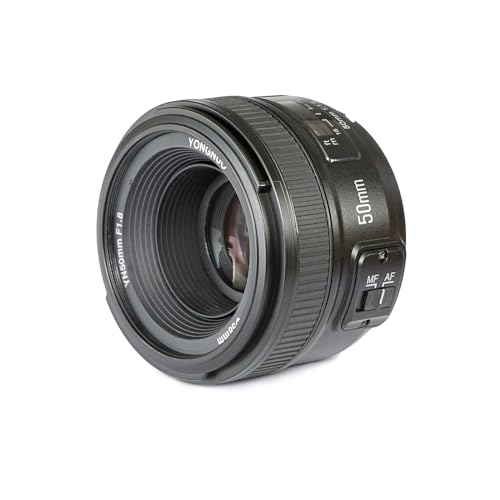
Yongnuo's YN50mm F1.8N gives Nikon shooters a bright prime that pairs well alongside a 12-50mm kit lens. Reviewers note it supports both autofocus and manual focus, plus full-frame and APS-C bodies. Gold plated metal contacts aim to improve signal conductivity and resist corrosion over time. Because it works with M, AV, TV, and P shooting modes, your settings still record correctly in EXIF data. The f/1.8 aperture opens the door to soft, blurred portrait backgrounds. One honest limitation: as a third-party lens for the Nikon F-mount, autofocus reliability can vary across camera bodies, so testing on your own gear first is wise.
Focal length50mm
Max aperturef/1.8
Focus modesAF and MF
MountNikon F
Pros
- Pairs naturally with a Nikon kit lens
- Works on full frame and APS-C bodies
- Records settings in EXIF across common shooting modes
Cons
- Third-party autofocus can vary by camera body
- Nikon F-mount only
Check price on Amazon ›
Sony's FE 50mm F1.8 leans on a compact, lightweight build made for full-frame e-mount cameras. Its large f/1.8 aperture and 7-blade circular design produce smooth, rounded bokeh behind a subject. Based on specifications, an aspherical element controls spherical aberration and coma, while a double-gauss layout suppresses field curvature and distortion. Reviewers note the small size makes it easy to carry all day for candid portraits. The bright aperture also helps in dim rooms without pushing ISO too far. One limitation: this lens is built for Sony e-mount, so it will not fit DSLR systems, and the light body trades some weather sealing for portability.
Focal length50mm
Max aperturef/1.8
Aperture blades7, circular
MountSony FE e-mount
Pros
- Compact, lightweight body for all-day carry
- 7-blade circular aperture for smooth bokeh
- Aspherical element curbs aberration and coma
Cons
- Sony e-mount only, no DSLR fit
- Light build offers limited sealing
Check price on Amazon ›
Nikon's AF-S FX NIKKOR 50mm f/1.8G is a compact FX-format prime built around a newly developed optical system with an aspherical element. A Silent Wave Motor drives quiet autofocus, and the M/A switch lets you fine-tune focus by hand mid-shot. Based on specifications, it is optimized for edge-to-edge sharpness on both FX and DX bodies, with a 0.45 meter minimum focus distance for framing head shots. The bright f/1.8 aperture delivers the shallow depth portraits rely on. A 58mm filter thread keeps accessories easy to source. One limitation: this is a fixed prime with no zoom, so you compose by physically moving closer or back.
Focal length50mm
Max aperturef/1.8
Min focus distance0.45 m
Filter thread58mm
Pros
- Edge-to-edge sharpness on FX and DX bodies
- Silent Wave Motor for quiet autofocus
- M/A switch for quick manual override
Cons
- No zoom, a fixed focal length
- Slightly longer minimum focus distance than rivals
Check price on Amazon ›
What to look for
Match the mount first
Before anything else, confirm which mount your camera uses. Canon EF, Nikon F, and Sony e-mount lenses are not interchangeable without an adapter. Buying the wrong mount is the most common mistake, so check your camera body's label carefully.
Why f/1.8 matters for faces
A wide f/1.8 aperture lets you throw the background into soft blur while a subject's eyes stay sharp. That separation is what makes portraits feel professional. It also gathers more light, helping in dim rooms without harsh flash.
Full frame versus APS-C framing
On a full-frame body a 50mm lens gives a natural, true-to-life view. Mount the same lens on an APS-C camera and the framing tightens to roughly 80mm, a length many portrait shooters prefer for flattering compression of facial features.
Autofocus and build quality
Look at the focus motor and construction. Stepping and silent wave motors keep autofocus quiet and smooth, which helps for video. Third-party options can save money but sometimes vary in focus reliability, so match expectations to your specific camera.
Frequently asked questions
Is a 50mm lens good for portraits?
Yes. A 50mm prime is a long-standing portrait favorite because its wide f/1.8 aperture blurs backgrounds while keeping faces crisp. On APS-C bodies it frames tighter, near 80mm, which flatters facial features.
Will these lenses fit any camera?
No. Each lens is built for a specific mount. The Canon fits EF DSLRs, the Nikon options fit F-mount, and the Sony fits e-mount. Always confirm your camera's mount before buying.
What does f/1.8 do for my photos?
A wide f/1.8 aperture creates a shallow depth of field, blurring the background behind your subject. It also lets in more light, so you can shoot in dim conditions without raising ISO too far.
Do I need autofocus or is manual fine?
Autofocus speeds up portrait sessions and helps with moving subjects. Several of these lenses also allow manual focus for precise control, letting you fine-tune focus on the eyes when needed.
Why choose a prime over a zoom?
Primes like these open wider than most zooms, giving stronger background blur and better low-light reach. They are usually more compact too. The trade-off is composing by moving your feet rather than twisting a zoom ring.
What is the crop factor on APS-C?
On APS-C cameras, a 50mm lens frames like roughly 80mm on full frame. That tighter view suits head-and-shoulders portraits and adds gentle compression that many photographers find flattering.
Are third-party lenses reliable?
Third-party primes can perform well and pair nicely with kit lenses. Reviewers note autofocus behavior can vary across camera bodies, so testing on your own gear early is a sensible step.
How close can these lenses focus?
Minimum focus distances here range from about 0.35 to 0.45 meter, depending on the lens. That is close enough for tight head shots and casual detail images without needing a dedicated macro lens.
The verdict
Canon EF 50mm f/1.8 STM Lens
9.2/10
For most Canon shooters, the EF 50mm f/1.8 STM is our top pick thanks to quiet focus and close framing. Nikon owners get edge-to-edge sharpness from the NIKKOR 50mm f/1.8G, while the Yongnuo suits those adding a first prime. Sony full-frame users will like the featherweight FE 50mm F1.8 for all-day carry. Match the mount to your camera, and any of these opens to f/1.8 for flattering portrait blur.
Check price on Amazon ›
Our top pick, secure checkout via Amazon
Note: Availability and specifications change often. Always confirm the current details on Amazon before buying.